
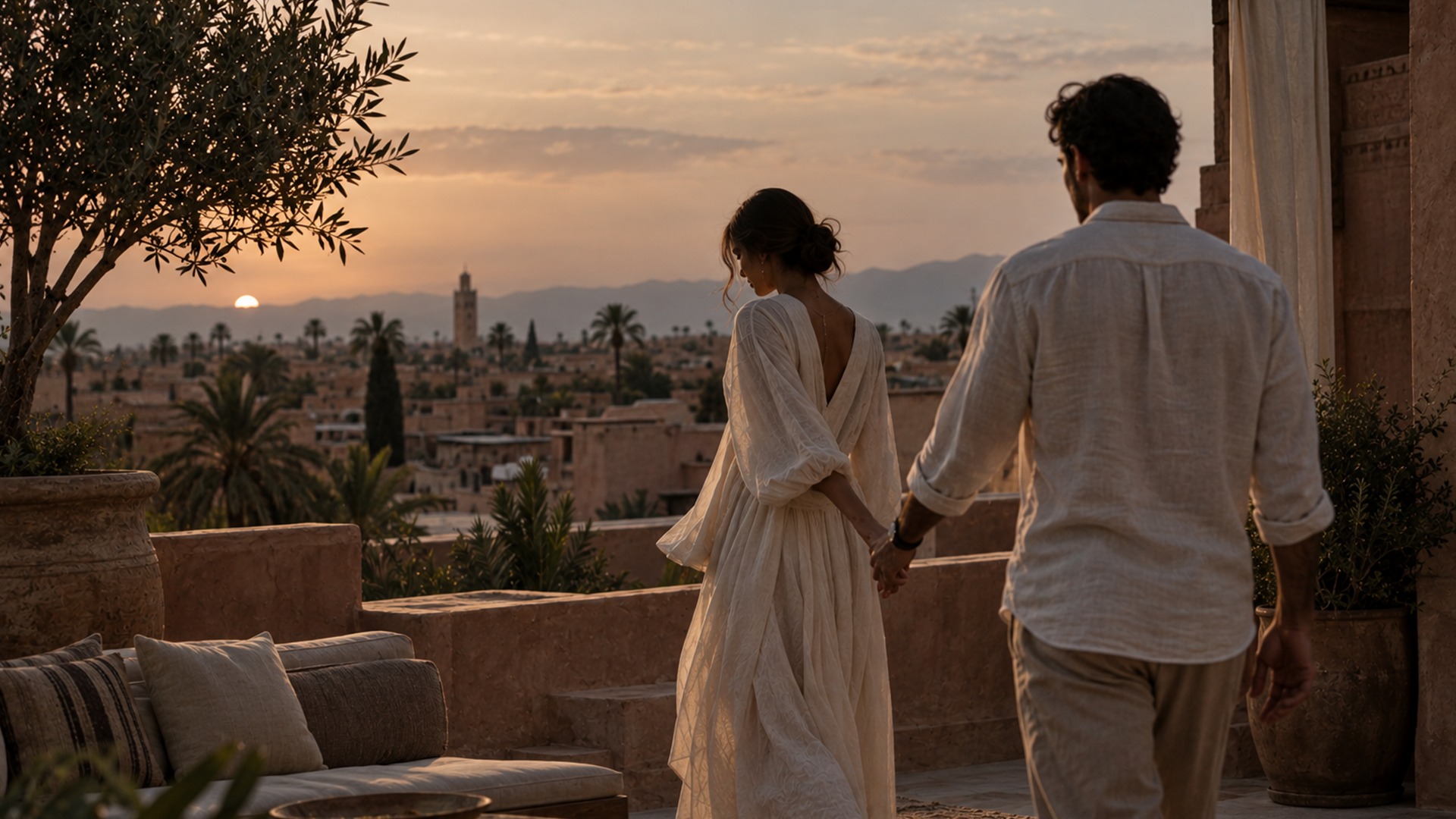
The instinct behind most honeymoon itineraries is to include everything, a version of the country too significant to trim, a list of experiences too meaningful to cut. This instinct, applied to Morocco, produces almost exactly the wrong result. The honeymoons that work best are usually not the ones that see the most. They're the ones that protect time. The same discipline, in fact, applies to planning any first journey through Morocco, honeymoon or otherwise.
Seven days is enough for two well-chosen bases, Marrakech and the Atlantic coast, say, done properly rather than rushed. Ten days opens a third region, most naturally the Sahara or the High Atlas, without every day becoming a transfer. Twelve to fourteen days allows genuine range: city, mountain, desert and coast, but only if the extra days go toward staying longer in fewer places, not visiting more of them.
The honeymoons that feel rushed almost never fail because the itinerary was too short. They fail because the itinerary was built for a longer trip and then compressed, leaving every day carrying the logistics of the version that would have needed more time.
Marrakech offers the strongest opening register: riads, craft, a genuine sense of arrival into somewhere unmistakably itself. The High Atlas, reachable within an hour or two of the city, offers real altitude, cooler air and a slower rhythm that contrasts well against Marrakech's density. The Sahara, considerably further away, offers the most singular single night of most Morocco honeymoons, but it is a genuine multi-day commitment once the travel time is honestly accounted for. Oualidia and the Atlantic coast offer the opposite register entirely: water, quiet, and very little to actively do, which is precisely the point after several days of cities and mountains.
The decision that matters most is choosing between desert and coast, rather than trying to fit both into a shorter trip. Both are worth experiencing; few honeymoon lengths comfortably accommodate both alongside Marrakech and the Atlas without turning several days into transit.
Riads' inward-facing architecture, courtyards, fountains, rooms arranged around a private interior rather than facing a street, creates a particular kind of privacy that a conventional hotel room, however well-appointed, doesn't replicate. For a honeymoon, this matters less as a luxury detail and more as a practical one: a riad simply offers a genuinely private space to return to, in a way that's structurally built into the architecture rather than dependent on room category or service level.
It's worth being direct about this, because the word gets used loosely: privacy on a Morocco honeymoon is created far more by pacing, transport and fewer transitions than by any single grand gesture or exclusive experience.
A private driver, arranged for the full journey rather than booked separately at each stop, removes the friction of logistics that otherwise punctuates a trip: no queuing, no navigating unfamiliar transport, no coordinating separate transfers between regions. Choosing accommodation with a genuinely private courtyard or terrace, rather than simply a higher room category, does more for the felt sense of privacy than upgrading within a conventional hotel typically achieves. And minimising one-night stays, the single biggest source of honeymoon exhaustion, protects more actual privacy and calm than any add-on experience could.
A useful planning discipline: count the number of times luggage gets packed and moved across the itinerary, and treat that number as a cost to be minimised, not a neutral fact of travel. Each transition, checking out, driving, checking in, consumes a portion of a day that could otherwise be spent simply being somewhere, and honeymoons are unusually sensitive to this cost given how much of their value lies in unstructured time together rather than sightseeing efficiency.
A workable rule: no fewer than two nights per base, and ideally three where a region genuinely rewards it, Marrakech and the coast both do.
Spring and autumn offer the most forgiving conditions across most of the regions a honeymoon itinerary is likely to combine: comfortable city and desert temperatures, pleasant coastal weather, mountain passes generally clear. Summer suits itineraries leaning toward the coast and mountains rather than cities and desert, given the interior heat by July and August. Winter offers its own appeal for honeymoons specifically drawn to the contrast between warm days in Marrakech and cold, star-filled desert nights, provided travellers pack properly for that contrast rather than assuming uniform warmth.
The strongest honeymoon experiences in Morocco tend to be specific rather than generic: a cooking class built around a region's actual cuisine, a hammam and spa session that's a genuine local tradition rather than an imported spa concept, a quiet dinner on a riad rooftop rather than a staged "romantic setup." What makes these work isn't elaborate theming; it's that they're genuinely rooted in where you are, rather than a version of romance that could be relocated to any destination without changing much.
Perhaps the single most underused honeymoon-planning tool is simply leaving unscheduled time: a morning with nothing booked, an afternoon with no planned activity. This is difficult to plan for precisely because it looks, on paper, like wasted itinerary space. In practice, it's usually where a honeymoon's best, least anticipated moments happen, and its absence is the most common reason honeymoons come home feeling like they were experienced through a schedule rather than together.
Marrakech's international airport is the natural arrival and departure point for most Morocco honeymoon itineraries, though Casablanca offers broader international connections worth checking against specific routing. As with any Morocco journey, international flights sit outside a private land itinerary and need arranging separately, worth settling early, since flight timing affects how the first and last days of the trip are structured.
Beyond the accommodation itself, "private" on a genuine Morocco honeymoon should mean: a driver and itinerary shaped around your pace rather than a fixed group schedule, experiences chosen for genuine relevance rather than generic inclusion, and enough unstructured time that the trip doesn't feel like it's being managed on your behalf. It should not require inventing claims about exclusive access or special treatment to feel true, the privacy comes from the structure of the trip itself, not from a promise layered on top of it.
One existing KaMabia route follows almost exactly this logic: seven days between Marrakech and Oualidia, built specifically around two people rather than a checklist. Written for Two is that journey.
For couples with more time and a wider crossing in mind, The Long Way Together carries the romantic journey across fourteen days and more of Morocco’s changing ground.