
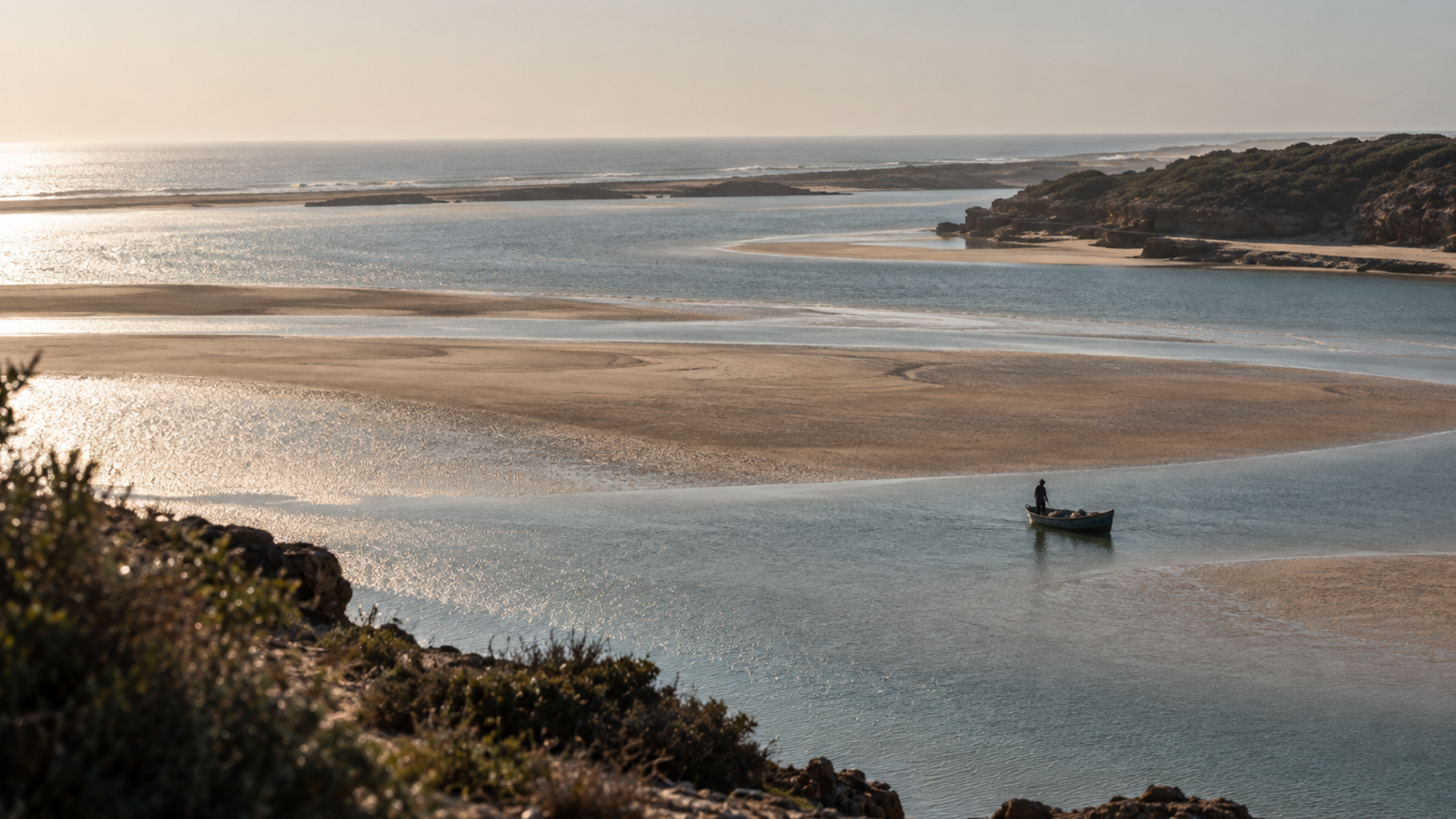
Oualidia is interesting largely because of how little seems to happen there. After the density of Marrakech or the working intensity of Fes, arriving at this lagoon on Morocco's Atlantic coast can feel almost disorienting in its quiet, not because there's nothing to do, but because the place simply doesn't ask anything of you.
Oualidia sits roughly midway along the coast between Casablanca and Essaouira, built around a genuine natural rarity for this stretch of Atlantic Morocco: a protected lagoon, separated from the open ocean by a long sandbar and rock barrier that breaks the swell before it reaches the inner water. This is the detail that defines the whole place. Where most of Morocco's Atlantic coast means real ocean, significant waves, strong currents, water that demands respect, Oualidia's lagoon is calm, shallow in large sections, and genuinely swimmable in a way the open coast rarely allows.
The relationship between lagoon and ocean shifts with the tide. At low tide, sandbanks emerge and the lagoon becomes a landscape of shallow pools and channels; at high tide, it fills into a broad, calm expanse considerably more suited to swimming, kayaking or simply floating than anywhere on the exposed coast nearby.
Swimming conditions in the lagoon are mild by Atlantic Moroccan standards, noticeably calmer and, in the shallower sections, noticeably warmer than the open sea, since the sandbar limits both wave action and the colder deep-water currents that keep much of the Atlantic coast bracing even in summer. This makes Oualidia unusually accommodating for travellers who want to actually swim rather than simply admire an ocean view from the shore.
Oualidia has been known for oyster cultivation for decades, and the lagoon's specific conditions, calm, nutrient-rich, tidally flushed water, are exactly what oyster farming requires. Several operations along the lagoon grow and sell oysters directly, often alongside simple, informal seafood restaurants where the day's catch, not a printed menu, effectively decides what's available.
This is where Oualidia's food culture is most distinctive: not elaborate restaurant dining, but oysters eaten within sight of where they were grown, and fish bought that morning from boats returning to the small local harbour.
Fishing remains a genuine local livelihood here, not a tourism performance: small boats work the lagoon and the nearby coast daily, and a walk along the water in early morning will usually pass more working fishermen than visitors. For travellers, kayaking on the calm lagoon water is a straightforward, low-effort way to see the place from a different angle, and a few operators offer simple boat trips across the lagoon, generally unhurried and informal rather than structured excursions.
Oualidia does not have significant nightlife, notable shopping, or a dense list of attractions, and it's worth being direct about that rather than implying otherwise. What it offers instead is walking, along the lagoon, along the sandbar at low tide, through the small town itself, time spent doing very little with intention, and food built around what the water actually produces. Travellers arriving expecting a fuller roster of activities, in the way a city or even Essaouira offers, will find Oualidia's appeal is specifically in that absence.
Summer brings the most activity, warmer water, more visitors, a livelier if still modest atmosphere around the lagoon's restaurants. Outside the summer months, Oualidia turns considerably quieter, which some travellers specifically seek out: fewer people, a calmer lagoon, and a slower version of an already slow place. Winter can bring more variable weather and cooler temperatures, worth checking against your specific travel dates, though the lagoon's protection from open-ocean swell means conditions remain milder here than at more exposed points along the coast even outside summer.
Essaouira, further south along the coast, is a genuine town: a fortified medina, a working port, restaurants, shops, wind sports, a considerably more developed visitor infrastructure. Oualidia is, by comparison, barely a town at all: a scattering of buildings around the lagoon, without Essaouira's medina, ramparts or comparable range of things to do.
The two aren't really substitutes for each other. Essaouira suits travellers who want a coastal town with genuine character and things to actively do. Oualidia suits travellers who specifically want the absence of that: a place to stop moving for a few days, built around water and food rather than sights.
Two nights is usually enough to properly settle into Oualidia's pace, one full day is workable but tends to feel rushed given the point of being there is slowness itself. Longer stays reward travellers whose itinerary genuinely has room for unstructured time, rather than those trying to fit Oualidia in as a brief stop between busier destinations.
It suits couples, honeymooners and anyone whose Morocco itinerary has, up to that point, been reasonably intensive, city medinas, mountain driving, desert distances, and who want a genuine change of register before departure rather than another destination to actively explore.
Geographically, Oualidia sits conveniently between Marrakech and Casablanca, making it a natural stop on a route that begins or ends near either city, rather than requiring a dedicated detour. For itineraries built around Marrakech, the Atlas and the desert, adding Oualidia as a final coastal stretch before departure, rather than treating the desert as the trip's natural conclusion, offers a genuinely different closing register: water and quiet after mountains and sand.
One existing KaMabia route follows precisely this pairing, Marrakech opening the journey, Oualidia closing it. Written for Two is built around exactly that shift in register.
Explore Oualidia as a place within KaMabia’s private journeys.