
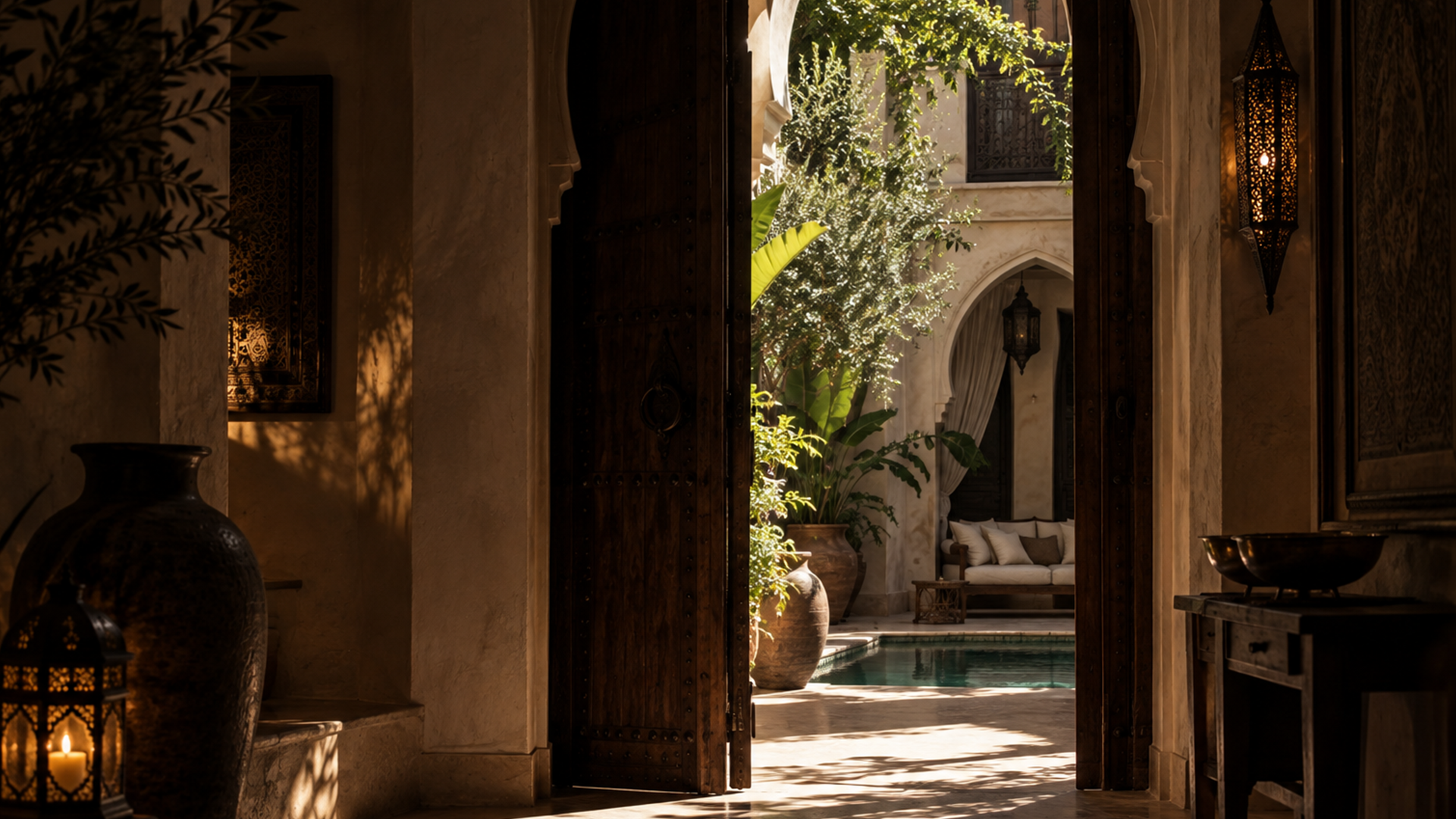
Before a riad was a place to stay, it was simply how a house in a Moroccan medina was built. Understanding that order, architecture first, hospitality industry considerably later, explains almost everything about why staying in one feels genuinely different from a conventional hotel, and why the difference isn't primarily aesthetic.
The defining feature of a traditional riad is that it faces inward. From the street, a riad presents a plain, often windowless wall and a single door, nothing to indicate what lies behind it. This isn't an accident of style; it's the architectural expression of a specific value placed on domestic privacy in traditional Moroccan urban life, where the street was public space and the home was deliberately, structurally separated from it.
Step through the door and the house reverses entirely: rooms open onto a central courtyard, often with a fountain, sometimes with citrus or olive trees planted directly into the floor, open to the sky above. Light, air and quiet all come from this interior void rather than from the street-facing exterior, which is precisely why a riad courtyard can feel remarkably calm even in the middle of a dense, busy medina just steps away.
The fountain or small pool at a riad's centre isn't purely decorative: in a hot climate, moving water helps cool the surrounding air, and the practice reflects a broader tradition, shared with Andalusian and wider Islamic architecture, of using water and planted courtyards as functional climate management as much as aesthetic choice. The same logic extends to the thick walls typical of older riads, which provide genuine insulation against exterior heat in a way modern lightweight construction often doesn't replicate.
Since the 1990s, a substantial wave of restoration has converted historic riad houses, many previously subdivided or falling into disrepair, into guesthouses, a process that saved a considerable amount of traditional medina architecture that might otherwise have been lost to neglect or demolition.
It's worth being precise about a related point: the word "riad" has become loosely applied to properties that don't actually share the traditional inward-facing courtyard form, simply because the term now carries strong marketing appeal. A genuine riad has that central courtyard structure; a property using the name purely for its Moroccan association may not. This distinction is worth checking before booking if the traditional architecture itself is part of what you're seeking.
The practical differences run deeper than architecture alone. Riads are typically small, often somewhere between four and fifteen rooms, which means a fundamentally different service style than a larger hotel: more personal, often involving direct relationships with staff who know guests individually rather than through a front-desk system. Breakfast and meals are frequently taken in the courtyard itself, part of the same intimate, contained experience rather than a separate hotel restaurant.
What riads generally don't offer, and are worth planning around: elevators are rare, given most occupy converted historic houses with narrow original staircases, meaning multiple floors without lift access is the norm rather than the exception, a genuine consideration for travellers with mobility concerns or heavy luggage. Many riads also sit deep enough within a medina's pedestrian-only lanes that cars and taxis cannot reach the door directly, meaning some walking, sometimes with a porter's help, is simply part of arrival and departure.
Medina noise is a genuine variable worth understanding honestly rather than romanticising away. A riad near a mosque will have the call to prayer audible, including before dawn; a riad near a busy lane may have daytime market sound filtering through despite thick walls. This isn't a flaw so much as an accurate reflection of staying inside a living, working urban space rather than an isolated resort, travellers who want complete acoustic isolation may find a riad, however well-restored, doesn't fully deliver that, and are better served knowing this before arrival rather than being surprised by it.
Because riads face inward at ground level, the rooftop terrace often becomes the property's primary connection to the wider city: views over the medina's rooftops, minarets and, on clear days, distant mountains, along with a natural gathering space for evening drinks or a quiet breakfast above the streets below. Many riads treat this rooftop as genuinely central to the experience, not an afterthought, and it's worth checking what rooftop access a specific property actually offers before booking.
Beyond photographs, the details worth checking before choosing a riad: exact location relative to the medina's gates and main landmarks, since navigation difficulty varies enormously by specific placement; whether the property is a genuine historic riad or a newer building using the name loosely; stair count and any accessibility concerns relevant to your specific needs; and what's actually included, some riads offer full board or guided orientation on arrival, which matters considerably for a first stay in an unfamiliar medina.
Staying in a riad, rather than a hotel outside the medina walls, fundamentally changes how a city is experienced: you're inside the same dense, layered urban fabric you're there to see, rather than commuting into it each day from a more conventional, more accessible hotel district. This proximity is part of what makes riad accommodation genuinely central to how Fes and Marrakech, in particular, are best experienced, rather than simply a stylistic choice layered on top of an otherwise identical trip.
The trade-off, less accessibility, more noise variability, more walking, is real, and worth weighing honestly against what a riad offers in return: a house built, centuries before hospitality was a consideration, specifically to create calm within a busy city, and a stay that puts you inside that logic rather than observing it from outside. Where a riad fits within a wider itinerary is, in turn, one part of the broader question of planning a first journey through Morocco.