
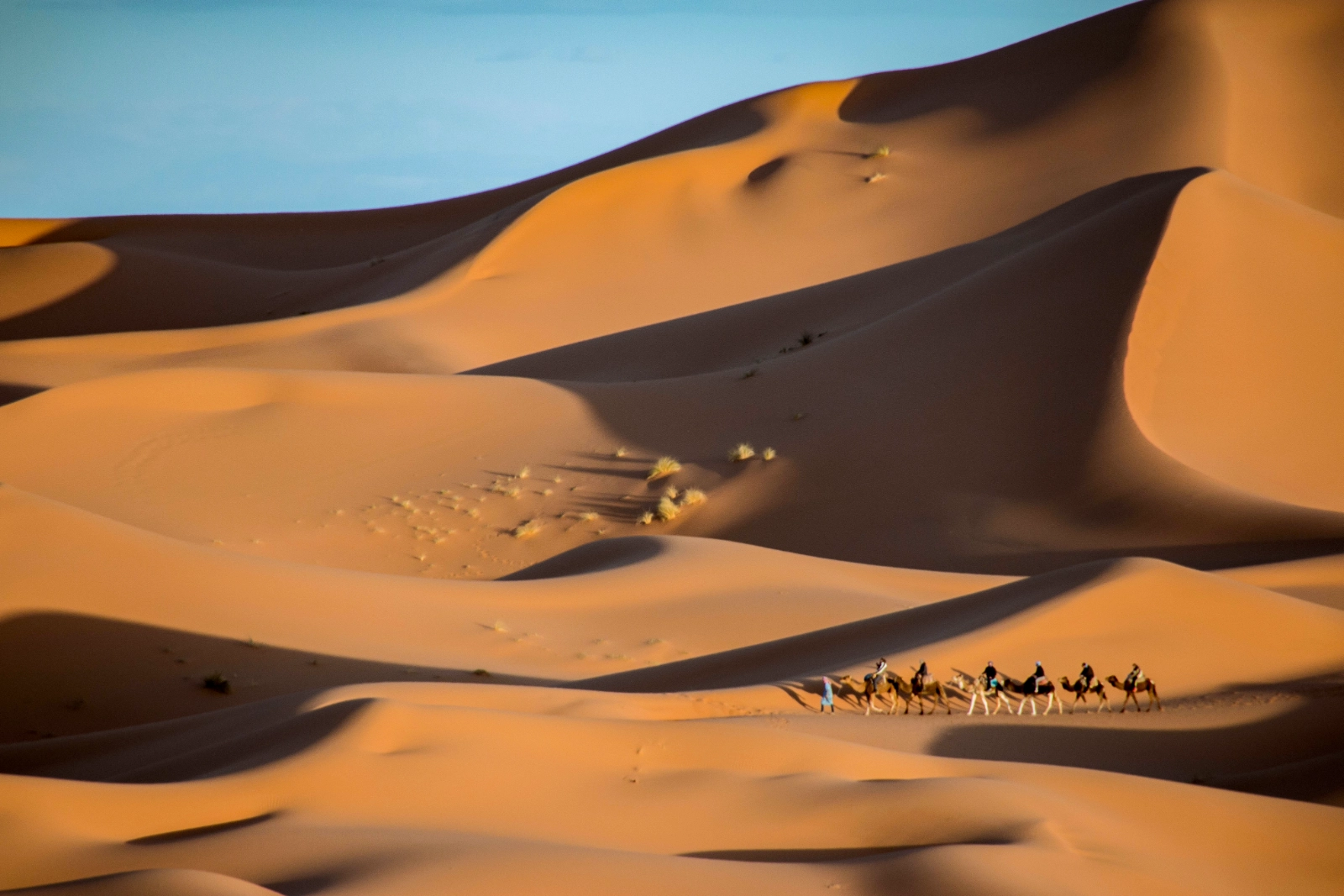
Morocco has two major dune fields that reach genuine sand-sea scale, and they are not interchangeable. Erg Chebbi, near Merzouga, is the one most travellers reach; Erg Chigaga, further south and west near M'Hamid, is the one people ask about once they've read that Erg Chebbi isn't actually all that remote anymore. Both claims contain real truth, and choosing between them is a genuinely useful decision rather than an arbitrary one.
Erg Chebbi is reached via Merzouga, itself roughly eight to nine hours' drive from Marrakech or six to seven from Fes, substantial, but served by a properly paved road the entire way, with the dunes themselves visible from town.
Erg Chigaga requires reaching M'Hamid first, itself a further two to three hours south of Zagora, before a final approach into the dunes that typically requires 4x4 transport across unpaved track rather than a paved road to the dune edge. In practical terms, reaching Chigaga from Marrakech is genuinely a two-day journey each way for most itineraries, not a variation on Erg Chebbi's already-long single day.
Erg Chebbi's dunes are the taller, more classically dramatic of the two, rising in places above 150 metres, concentrated in a relatively compact, easily photographed erg that delivers a strong, immediate visual impact.
Erg Chigaga is larger in total area and, in most descriptions, feels more expansive and less contained: a sea of dunes rather than a single dramatic ridge, with a corresponding sense of scale that some travellers find more impressive precisely because it's harder to take in from one viewpoint.
Erg Chebbi's proximity to Merzouga has produced considerably more camp infrastructure and competition over recent decades, a wide range of camp qualities exist, from very basic to genuinely well-appointed, with correspondingly more choice for travellers with specific comfort requirements.
Erg Chigaga's greater remoteness means fewer camps overall and, generally, a more consistent, deliberately simple style across most of them, fewer options, but a more uniform experience of genuine isolation rather than a range running from basic to elaborate.
This is the real substance of the comparison. Erg Chebbi, while still a genuine desert experience, sits within a more developed travel corridor: other camps' lights are sometimes visible in the distance, and the drive in doesn't feel like leaving the world behind so much as reaching a specific, well-established destination.
Erg Chigaga's remoteness is considerably more real. The approach genuinely feels like traveling beyond infrastructure, and the resulting silence and sense of isolation are correspondingly deeper, which is precisely what draws travellers who've done Erg Chebbi before and want something that feels less established.
Merzouga itself has grown into a genuine, if small, town built substantially around desert tourism, offering options for a night before or after the dune experience without needing to backtrack far.
M'Hamid is smaller and less developed for tourism specifically, functioning more as a genuine last-town-before-the-desert waypoint than a destination in its own right, useful context for travellers assuming it will offer Merzouga-equivalent amenities.
Erg Chebbi is the more sensible choice for first-time Sahara visitors, travellers with limited time, or anyone prioritising a strong, reliable dune experience without the additional driving days that Chigaga requires. It's also the better choice for anyone wanting a wider range of camp comfort levels to choose from.
Erg Chigaga suits travellers who have either done Erg Chebbi already or who specifically want the deeper isolation and more genuine sense of remoteness, and who have the additional time, realistically, most of a week beyond the rest of an itinerary, that reaching it properly requires.
Erg Chebbi can be reasonably incorporated into a broader itinerary with two to three additional days beyond the core route, including the overnight stop that makes the drive sensible rather than exhausting.
Erg Chigaga genuinely needs to be planned as a dedicated southern loop, typically adding four to five days when the M'Hamid approach and return are properly accounted for, not something easily folded into a standard Marrakech-and-desert itinerary without displacing other regions.
Neither erg is categorically better. Erg Chebbi offers a strong, reliable, well-supported desert experience reachable within a standard itinerary's time budget. Erg Chigaga offers genuinely deeper remoteness at the cost of considerably more travel time and less infrastructure choice.
For a first Sahara experience, or any itinerary where the desert is one significant component among several, Erg Chebbi is almost always the more practical choice. For travellers specifically prioritising isolation above convenience, with the extra days available to reach it properly, Erg Chigaga delivers something Erg Chebbi, however genuine its own remoteness, simply cannot match.
One existing KaMabia route reaches Erg Chebbi as part of a longer southern crossing rather than an isolated add-on: eleven days from Marrakech through saffron country and kasbah territory to the dunes and back. South of the Wall is that journey.