
The first thing most people get wrong about the Sahara is the distance. It sits considerably further from Marrakech than most itineraries imply, and being honest about that distance changes how well the desert portion of a Morocco trip actually works.
Erg Chebbi, the dune field near Merzouga most commonly associated with a Moroccan desert experience, is roughly a full day's drive from Marrakech, typically eight to nine hours of driving if done in one push, though almost nobody who has done this route recommends attempting it that way. The much more sensible approach breaks the journey with an overnight stop, commonly in Dadès Gorge or Skoura, turning what would be an exhausting single push into two genuinely interesting travel days through the Todra Gorge and the kasbah country of the south.
From Fes, the drive is somewhat shorter but still substantial, typically six to seven hours through the Middle Atlas cedar forests and down toward the desert's edge. Neither route is a quick add-on to a city-focused trip, and any itinerary presenting Erg Chebbi as an easy day trip from Marrakech is not describing something that actually exists.
Erg Chebbi is a genuine sand-dune erg, not the flatter, rockier terrain that covers most of Morocco's Saharan-adjacent landscape, but proper wind-shaped dunes, some rising over 150 metres. This specific quality of landscape is comparatively rare within Moroccan Sahara access points, which is part of why Merzouga became the primary desert-camp destination in the first place. It is not the only dune field Morocco offers, and travellers weighing it against the more remote Erg Chigaga further south will find that comparison covered separately.
Most desert-camp experiences involve a final stretch by camel or 4x4 from a fixed vehicle drop-off point into the dunes proper, since standard vehicles can't manage the sand itself. Camel transport, the more traditional option, takes considerably longer, often forty-five minutes to an hour into camp, but offers a genuinely different, slower arrival than a 4x4 transfer, which covers the same ground in a fraction of the time with considerably more comfort for anyone with back or joint concerns.
Neither option is objectively better; the choice mostly comes down to how much the camel experience itself matters to you versus simply wanting to arrive at camp with minimum discomfort.
Camp styles vary considerably. At the simpler end, tents are canvas structures with basic bedding and shared or minimal facilities. At the more developed end, increasingly common at the better-established camps, tents include proper beds, private bathrooms and sometimes electricity, without losing the fundamental experience of sleeping in the desert.
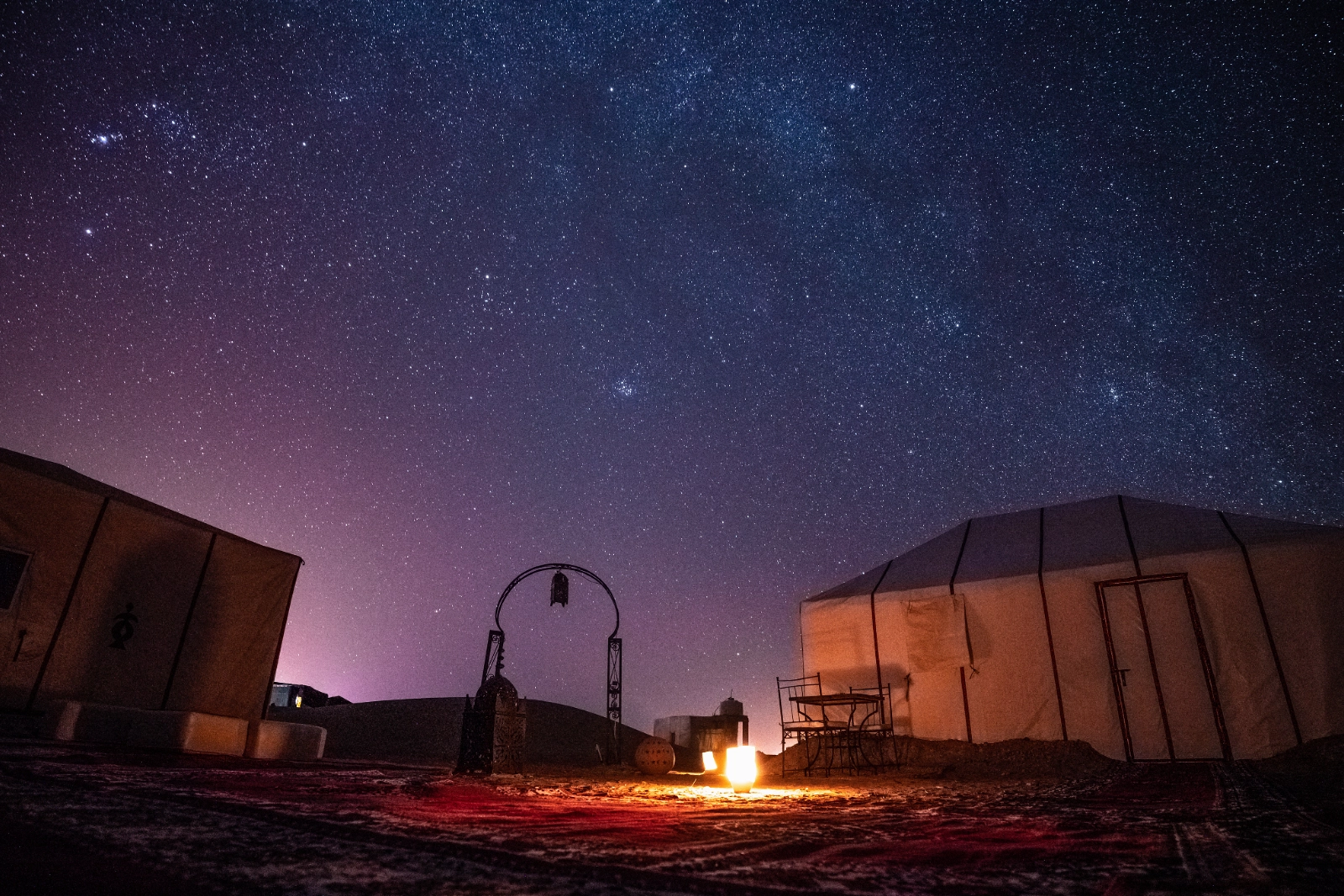
What doesn't vary much regardless of camp style: dinner is typically communal, often built around tagine cooked over fire, and the evening's main event is simply the sky, with minimal light pollution, Saharan night skies genuinely deliver on the reputation, particularly around new moon.
Sunset over the dunes is the moment most photographed and most anticipated, and it generally lives up to that anticipation: the colour shift across sand happens faster and more dramatically than most people expect. Dawn is less universally prioritised by camps' standard schedules but arguably just as worthwhile, with a stillness and cooler light that sunset's more social, arrival-adjacent timing doesn't offer.
Camps that build in a genuine, unhurried dawn, rather than treating it purely as a photo stop before departure, tend to produce the more memorable experience.
This is where the Sahara most consistently surprises people. Daytime temperatures, particularly outside summer, are often comfortably warm rather than extreme, but desert nights drop sharply once the sun sets, since sand doesn't retain heat the way denser terrain does. Depending on season, night temperatures can fall to genuinely cold, particularly in winter months, when temperatures near freezing after dark are entirely possible despite a warm afternoon.
Proper layering, including something genuinely warm for after dinner, not just a light jacket, is essential regardless of when you're visiting, and travellers who pack only for daytime heat consistently regret it once the sun goes down.
Away from camp activity, the deep desert has essentially no ambient sound: no traffic, no consistent wind unless conditions produce one, no insects at the volume found elsewhere. This genuinely surprises people who arrive expecting some baseline level of nature sound and instead encounter something closer to true quiet, which some travellers find immediately calming and others initially find slightly unsettling before adjusting.
Beyond warm layers for the evening: a headlamp or torch, since camps have minimal lighting after dark; sunglasses and sun protection for daytime dune walking, where reflected light is considerably more intense than the ambient temperature alone suggests; and comfortable closed shoes for walking on sand, which is more physically demanding than it looks over any real distance.
One night is the realistic minimum to make the long drive worthwhile, but two nights allow a genuine full day at the camp itself, time to properly explore the dunes, rest after the drive, and experience both a sunset and a following dawn without the rush of a single-night stopover. Given how substantial the journey there and back is, most experienced Morocco travellers consider the extra night a better use of time than trying to reclaim a day elsewhere in the itinerary.
Agafay, the stone desert roughly thirty minutes from Marrakech, has become a popular substitute for travellers short on time, and it's a genuinely striking, rocky, lunar landscape worth visiting on its own terms. What it is not is the Sahara: no dunes, a shorter drive, a different silence, and a fundamentally different landscape despite frequently being marketed using desert-camp language that implies otherwise. An itinerary offering "one night in the Sahara" as an easy add-on from Marrakech is, with near certainty, describing Agafay rather than Erg Chebbi.
Neither is better than the other, they simply answer different questions about how much time you have and what you actually want from a desert night. For readers weighing Erg Chebbi against the considerably more remote Erg Chigaga, that comparison follows a similar logic: convenience against isolation. A longer discussion of Agafay itself, and how it compares against the true Sahara, runs through our Morocco travel guide.
For travellers ready to make the journey properly, one KaMabia route reaches Erg Chebbi as the centrepiece of an eleven-day southern crossing. South of the Wall is that journey.