
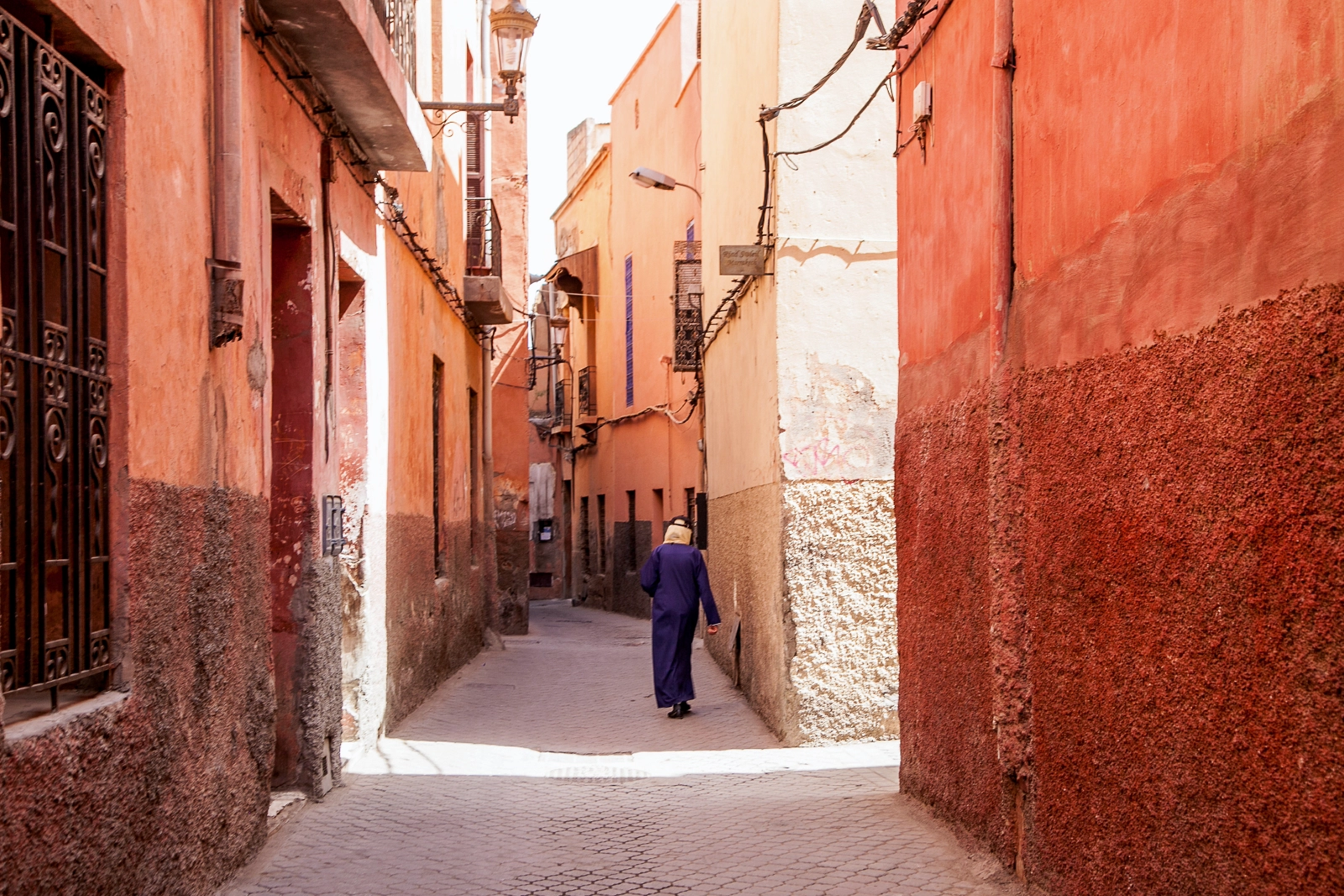
Marrakech has a problem most cities would envy: it is too photogenic for its own good. Decades of riad interiors, souk doorways and rooftop sunsets have flattened the city, in a lot of people's minds before they've even arrived, into a fairly narrow set of images. The actual city is larger, stranger and considerably more varied than that set suggests.
Marrakech at six in the morning is close to a different place. The medina's lanes, filled by midday with handcarts, motorbikes and the general density of a working city, are quiet enough to hear a broom against stone, a shutter going up, the first calls to prayer overlapping from different directions across the old city. This window, roughly dawn until the shops properly open, is when the medina's actual scale and architecture are easiest to notice, uncompeted with by crowd or commerce.
It's a genuinely different way to experience streets that, by afternoon, are primarily experienced as obstacles to navigate around other people.
Jemaa el-Fnaa, the city's central square, deserves a more honest description than either the breathless "greatest show on earth" framing or the dismissive "tourist trap" one, because it is genuinely both a historic public space that predates mass tourism by centuries and a place now substantially shaped by that tourism's presence.
By day, it functions largely as a market and transit space. By evening, it transforms into something closer to its reputation: food stalls, storytellers, musicians, snake charmers whose presence is worth being aware draws animal-welfare criticism that's reasonable to take seriously when deciding whether to engage with that specific part of the square. The honest version of visiting Jemaa el-Fnaa treats it as neither essential spectacle nor something to avoid, but as one genuinely interesting register of the city among several, best experienced without over-planning the visit around it.
The Bahia Palace, built in the late nineteenth century for a grand vizier, is Marrakech's clearest architectural argument for slowing down: room after room of carved cedar, painted ceilings and zellige, built specifically to demonstrate that ornament, used with restraint and rhythm, produces calm rather than visual noise.
The Saadian Tombs, rediscovered only in 1917 after being sealed for centuries, offer a quieter, more intimate scale, genuinely worth the wait in line that their popularity now creates. And the Ben Youssef Madrasa, a former Islamic college, is arguably the single best piece of pure architecture in the city for visitors specifically interested in geometric pattern and craft, without the crowds that the more famous sites now draw.
The Majorelle Garden, saved from redevelopment and restored by Yves Saint Laurent and Pierre Bergé, who found in its cobalt-blue architecture and desert planting a palette that influenced Saint Laurent's design work for the rest of his career, is small, frequently busy, and still genuinely worth the visit, ideally at opening time before tour groups arrive in volume.
Less visited but comparably interesting: the Menara Gardens, an olive grove and reflecting pool dating to the twelfth century, which offers a considerably quieter version of green space within easy reach of the city.
Beyond the souks proper, Marrakech's craft traditions are visible in specific working neighbourhoods: dyers, metalworkers, woodworkers, each historically clustered by trade in ways still partially visible in the medina's layout. Guéliz, the city's more contemporary district built up under the French protectorate and expanded considerably since, offers a genuinely different Marrakech: galleries, design studios and a restaurant scene less oriented toward tourist expectation than the medina's.
Food in Marrakech ranges from the elaborate, multi-course meals built around tagine, pastilla and mechoui in riad settings, to street-level snacking that residents actually eat daily rather than dishes primarily served to visitors. Both are worth seeking out; treating one as more "authentic" than the other tends to miss that both are simply different registers of the same city's food culture.
As temperatures drop after sunset, Marrakech's evening register shifts again: rooftop terraces across the medina catch the last light over the Koutoubia minaret, and a different, slower pace takes over from the day's commercial intensity. This is often where Marrakech's reputation for atmosphere is genuinely earned, away from any specific named venue.
One of Marrakech's genuine advantages, easy to overlook when planning a city-focused stay, is how close real mountain landscape sits to it. The High Atlas foothills begin within roughly an hour's drive, offering a legitimate change of altitude, temperature and pace without requiring a multi-day detour, useful context for travellers deciding how to balance city time against the wider region.
Marrakech is not undiscovered, and any article that implies otherwise is not being straight with you. It is one of Morocco's most visited cities, and certain areas, the most photographed medina lanes, the busiest sections of Jemaa el-Fnaa, genuinely show the effects of that volume, particularly during peak season.
This doesn't make the city less worth visiting. It does mean that the more rewarding version of a Marrakech stay usually involves deliberately building in time away from the most concentrated tourist circuits, the early mornings, the Guéliz neighbourhoods, the less-photographed madrasas, rather than assuming the well-known highlights alone will define the experience.
Three nights is a reasonable minimum to move past a purely surface-level visit, enough for the medina's major sites, at least one quieter neighbourhood, and a morning without a fixed itinerary. Travellers combining Marrakech with the Atlas or the desert often find four nights split across an arrival stay and a return stay works better than one continuous block, letting the city bookend rather than dominate the wider trip.
For a fuller sense of the city within a private journey, explore Marrakech.