
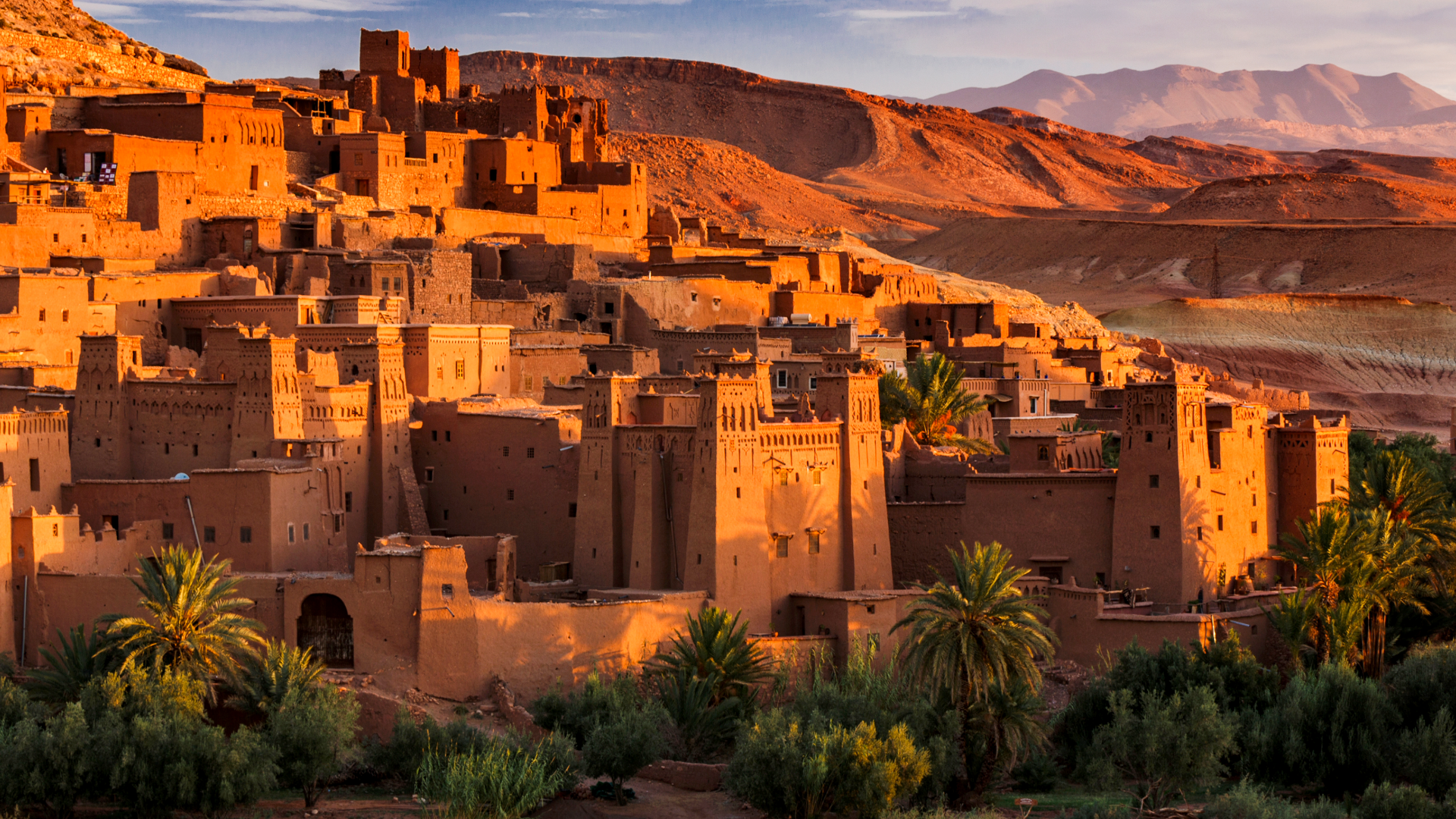
A fifteen-day passage from Morocco's Atlantic cities to its imperial heart, Sahara, High Atlas and the coast of Essaouira.
The days below show how this journey is intended to flow. Each one can be adjusted once we start planning together.
The Atlantic edge, then the weight of history.
A private arrival with fast-track assistance, and a day left open before the journey begins.
A private driver meets you on arrival, with fast-track assistance clearing the way to an unhurried first day.
Nothing is scheduled beyond settling in before the journey properly begins tomorrow.
A half-day privately guided exploration of Rabat: the Hassan Tower, the Mausoleum of Mohammed V and the Kasbah of the Oudayas.
A short drive brings you to Rabat, Morocco's dignified working capital.
A half-day privately guided exploration takes in the Hassan Tower, the Mausoleum of Mohammed V and the whitewashed Kasbah of the Oudayas.
The Roman ruins of Volubilis and imperial Meknes precede arrival in Fez.
The road continues through the Roman ruins of Volubilis and the imperial city of Meknes, with a private visit to both and, where arranged, a wine-tasting lunch.
By evening, the road narrows into Fez, arriving at its oldest medina.
A full day inside Fez's medina: tanneries, artisan quarters and historic monuments.
A full day inside Fez's medina: the tanneries, the artisan quarters, and historic monuments that mark the city's spiritual weight.
This is a city best explored on foot, at whatever pace the medina itself sets.
The journey's furthest point from the coast.
A Middle Atlas transfer and a sunset camel ride into the dunes of Erg Chebbi.
The road crosses the Middle Atlas toward Merzouga, where 4x4 vehicles take over for the final stretch to the dunes.
A camel crossing carries you into Erg Chebbi to watch sunset, with dinner and the night spent in a desert tent.
Earthen kasbahs and palm groves.
The Todra Gorge and the Dades Valley precede arrival in Skoura's palm groves.
The road leaves the desert behind, tracing the Todra Gorge and the Dades Valley, the corridor long known as the Road of a Thousand Kasbahs, before continuing into Skoura's palm groves by evening.
A guided walk through Skoura's palm groves, with the afternoon left at leisure.
A guided walk through Skoura's palmeraie: date palms and irrigation channels shaping an oasis that feels entirely apart from the desert just crossed.
The afternoon is left at leisure.
Hospitality rather than sightseeing.
A scenic, partly off-road crossing of the High Atlas via the Tizi n'Tichka pass.
The road climbs toward the High Atlas via the Tizi n'Tichka pass, partly off-road, through some of the range's most dramatic scenery.
The day ends at a mountain lodge, the altitude changing the pace of everything around it.
A day with an Amazigh family: bread, tagine, and a visit to the Assafou Foundation.
A day spent with an Amazigh family, baking bread, cooking tagine, and learning the customs of a household rather than observing from a distance.
Where arranged, the day continues with a visit to the Assafou Foundation, where local women practise weaving traditions passed down through the region. The visit is a chance to see the craft itself and the people who hold that knowledge, not a staged demonstration.
Where the journey completes its arc.
A scenic descent through the Atlas foothills brings the Atlantic back into view at Essaouira.
The road descends through the Atlas foothills, and somewhere in that descent the Atlantic reappears. It is the same ocean left behind on the first morning in Casablanca, reached now by a considerably longer route, through imperial cities, a desert crossing, an oasis and a mountain range.
The remainder of the day is left to settle into Essaouira, a coastal town that feels entirely unlike anywhere the journey has passed through since.
A walking tour of Essaouira's medina and ramparts, followed by a pastry-making workshop.
A morning walking tour takes in Essaouira's medina, harbour, beach and ramparts, a fortified port town with a different character entirely from anywhere else on the route.
The afternoon turns hands-on with a pastry workshop, learning to make almond gazelle horns and orange-blossom biscuits.
The final transfer to Marrakech, with an optional stop at a women's argan-oil co-operative.
The road turns inland toward Marrakech, with an optional stop where a women's co-operative produces argan oil.
By evening, the city's energy replaces the coast's quieter register.
The Saadian Tombs and the Badi and Bahia Palaces, ending in the souks at Djemaa el Fna.
A guided tour takes in Marrakech's principal sites: the Koutoubia Mosque, the Saadian Tombs, and the Badi and Bahia Palaces.
The afternoon opens into the souks, ending at Djemaa el Fna as the square finds its evening rhythm.
A shared cooking class by day, a weather-permitting evening balloon flight to close.
A shared cooking class introduces a handful of Moroccan dishes, learned directly from a dada, the traditional term for the women who have long carried Moroccan home cooking and taught it within their households.
Where weather allows, the evening closes with a hot-air balloon rising above Marrakech and the surrounding plains, dependent entirely on conditions, not a guaranteed close to the day.
A private transfer with fast-track assistance closes fifteen days across Morocco.
A private transfer with fast-track assistance carries you to the airport, closing fifteen days that moved from the Atlantic through imperial cities, desert, mountains and coast.
The journey leaves several distinct impressions rather than one single story: the particular light of Casablanca and Rabat, the quiet of a single desert night, an afternoon of bread and tea in a mountain home, the salt air of Essaouira, and Marrakech holding all of it at the close.
Fifteen days is enough to notice how the country changes, not enough to claim to know it completely.