
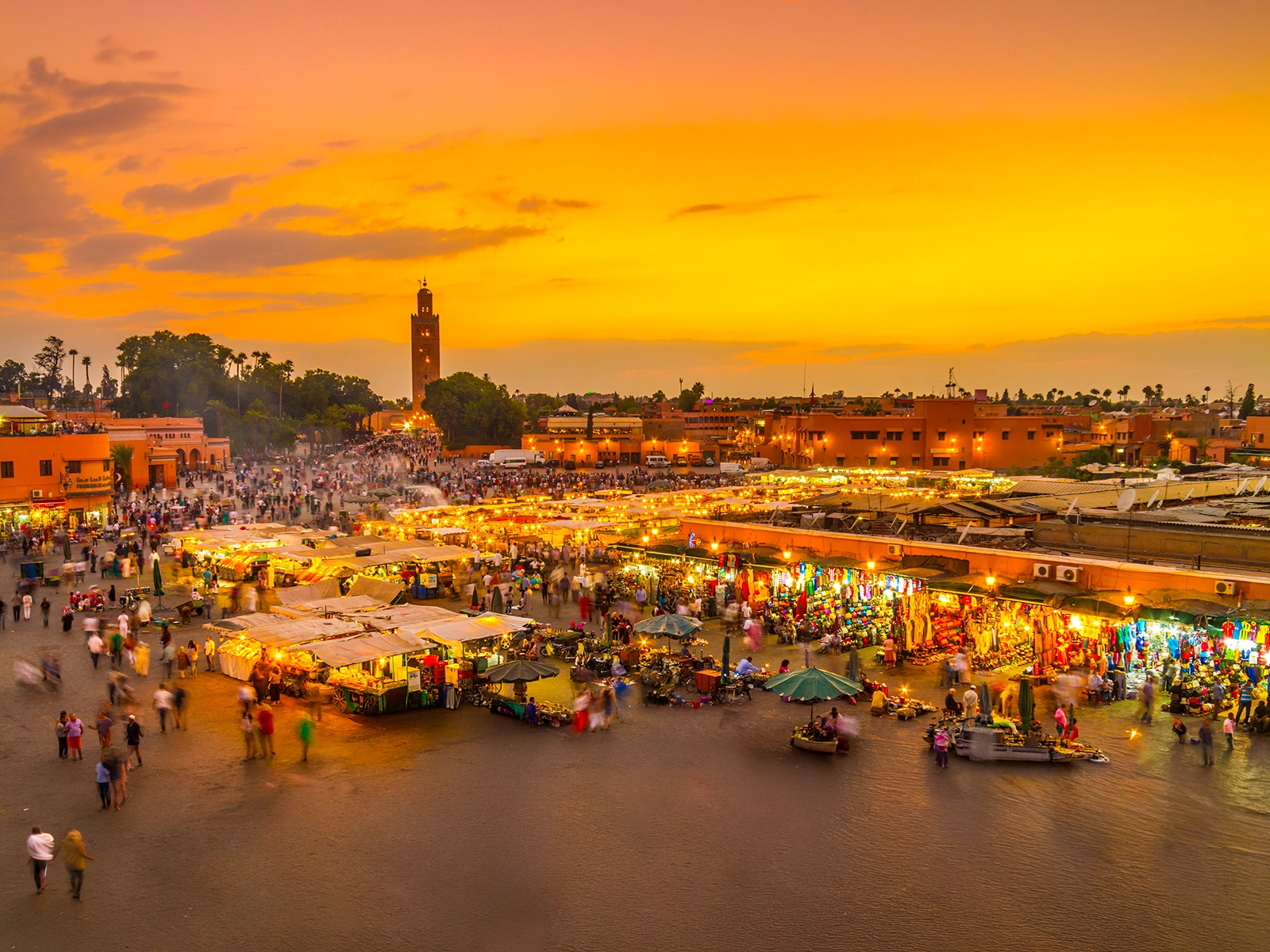
There is a specific stretch of road south of Ouarzazate where the land turns the colour of rust and the light seems to come from underneath the ground as much as above it. Filmmakers have a name for this kind of light, magic hour, the brief window at dawn and dusk when shadows lengthen and colour saturates without the harshness of midday sun. In southern Morocco, something close to that quality holds for much longer than an hour, and it has been pulling film crews here for decades.
But light alone doesn't explain it. What explains it is a combination of geography, architecture, infrastructure and cost that happens to let Morocco stand in convincingly for places it isn't, ancient Rome, biblical Judea, Tibet, invented fantasy kingdoms, more often and more affordably than almost anywhere else on earth.
Morocco's usefulness to filmmakers starts with genuine geographic range packed into a relatively compact, drivable country. Within a few hours of Marrakech, a production can move from snow-capped peaks in the High Atlas to red desert plateau to palm-lined valleys, without the location fees, permits and logistics of shooting across several different countries to get the same visual variety.
The architecture does real work too. Ksour, the fortified earthen settlements found across the south, have a monumental, ancient quality that reads on camera as almost any pre-modern civilisation, because their building material and form predate any specific national style a viewer might immediately recognise. Aït Ben Haddou, a UNESCO World Heritage site and the best-known of these ksour, has appeared across a range of productions precisely because its layered mud-brick towers look convincingly ancient without belonging unmistakably to one place or period.
It's worth pausing on why this doubling works as well as it does, because it isn't simply that ksour look old. Rammed earth and mud-brick construction, built from the same materials the land itself provides, using techniques with genuine antiquity across North Africa and the wider Middle East, doesn't carry the specific stylistic markers that would tie a building to one identifiable culture the way, say, a Gothic cathedral or a pagoda roofline immediately would.
A production designer working with ksour architecture is essentially working with a visual language old and geographically ambiguous enough to plausibly represent ancient Egypt, first-century Judea, or an entirely invented fantasy kingdom, often with only modest set dressing required to shift the reading from one to another. This ambiguity is a genuine production asset, not an accident of underdevelopment, it's precisely why the same landscape has convincingly played such different places across different films.
Ouarzazate, sometimes described as the gateway to the Sahara, has grown a genuine film infrastructure around this demand: studio facilities including Atlas Studios, along with a deep pool of local crew experience built up over decades of productions. Standing sets and props from past productions are sometimes still visible around the studios, left in the desert rather than dismantled.
The town and its surrounding landscapes have stood in for ancient Egypt, the Himalayas and other historical and fictional settings across numerous film and television productions since the 1980s. Ridley Scott's Gladiator used Ouarzazate for its Roman-set sequences. Martin Scorsese's Kundun, about the early life of the Dalai Lama, filmed its Tibetan scenes here. Aït Ben Haddou and other southern locations have also featured in several seasons of Game of Thrones, standing in for the city of Astapor among other locations. This list is illustrative rather than exhaustive, Morocco's film history runs considerably deeper than any single article can cover, and specific credits are worth verifying against a production's own records rather than treated as settled fact from secondhand sources.
What separates Ouarzazate from a merely photogenic backdrop is that it has become genuine production infrastructure over roughly four decades of near-continuous use. Atlas Studios and the smaller CLA Studios nearby offer sound stages, standing backlots and workshop space that mean a production doesn't need to build every structure from raw desert, some sets, particularly ancient-world or Middle Eastern facades, already exist in some form and can be adapted rather than constructed from nothing.
Equally significant, and less visible on screen, is the accumulated local crew experience: carpenters, plasterers, drivers, fixers and skilled labourers who have worked productions for years and understand, in practical terms, how to build at scale in desert conditions. This kind of institutional knowledge takes decades to develop and is genuinely difficult for a location to replicate quickly, which is part of why Morocco's advantage over newer filming destinations isn't purely about landscape.
Ouarzazate's climate, hot, dry, with reliably clear skies for much of the year, is itself a production advantage, since weather delays are costly and southern Morocco offers unusually predictable shooting conditions outside the height of summer. Spring and autumn, when temperatures are more manageable for cast and crew working long days outdoors, are accordingly the seasons when the heaviest production activity tends to cluster, similar to the seasonal logic that shapes when travellers visit the same region.
While Ouarzazate built its reputation as a stand-in for other places, Marrakech built a different kind of cultural pull: as itself, rather than as a substitute for anywhere else.
From the mid-twentieth century onward, the city drew a particular kind of visitor: artists, designers and public figures for whom Marrakech offered a specific combination of visual richness and relative privacy. Yves Saint Laurent's long relationship with the city, and his restoration of the Majorelle Garden, is probably the best-documented example, he credited Morocco's colour and light as a lasting influence on his design work, and the garden itself, now open to visitors, remains a direct trace of that relationship. Marrakech's reputation as a place where visual sensibility and discretion coexist predates its more recent tourism growth by several decades.
None of this happens by accident, and it isn't purely about how a location looks through a lens. Morocco has actively developed film-friendly policy: tax incentives, streamlined permitting through bodies like the Moroccan Cinema Centre, and a base of experienced local crew and equipment, that makes large productions genuinely more affordable to shoot here than in many alternative locations offering similar visuals. A production considering ancient-world or desert settings is often comparing Morocco's overall cost, not just its landscape, against the alternatives.
This combination, geography, architecture, established infrastructure and favourable economics, is why Morocco keeps appearing on screen, decade after decade, across genres that have very little in common with each other beyond needing somewhere that doesn't look like anywhere else in particular.
Morocco's screen history has, inevitably, shaped what many travellers arrive expecting: a landscape that feels cinematic almost by association, before they've seen a single frame of it in person. This isn't entirely misleading; the same light and architecture that convinced film crews to keep returning genuinely does photograph and feel remarkable in person. But it's worth arriving aware that Aït Ben Haddou and Ouarzazate are also simply real places with their own daily life and history, not sets awaiting a production, and that the more rewarding visit treats the film association as one interesting layer rather than the whole reason for being there.
Most visitors to Ouarzazate and Aït Ben Haddou come specifically because of a film or series they recognise, and that recognition is a genuinely good reason to visit, walking through a location you've watched on screen changes how you see both. But the more interesting version of that visit treats the film connection as one layer, not the whole story.
Aït Ben Haddou is also simply a remarkable piece of pre-Saharan architecture, still partially inhabited, built from rammed earth using techniques that predate any film crew by centuries. Ouarzazate is also a genuine desert town with its own rhythm, not just a backlot. Seeing both properly, not rushing between recognisable film spots, usually means slowing down enough to notice the place underneath the association, which is often where it becomes more interesting rather than less.